A Shape for What We Could Not Plan
Responding to the Matriarch’s Call — Essay Three
Entering the dance
By the time the first Journey of Inquiry had a route, four places, and women ready to co-host, a new kind of question was opening between us.
We had said yes. Now we needed to discover what we were saying yes to together.
There would be women arriving in these homes, bringing their lives, their questions, and whatever had drawn them toward the Matriarch’s Call. We wanted to welcome them into something we had taken special care to prepare. We also wanted to remain available to the encounter itself, to what could become visible only when those particular women were together.
I felt great joy in discovering that my collaboration partners shared an understanding of structure and emergence as one of life’s Sacred Paradoxes.
Sharing an acceptance of this paradox allowed our preparation to unfold in beautiful alignment.
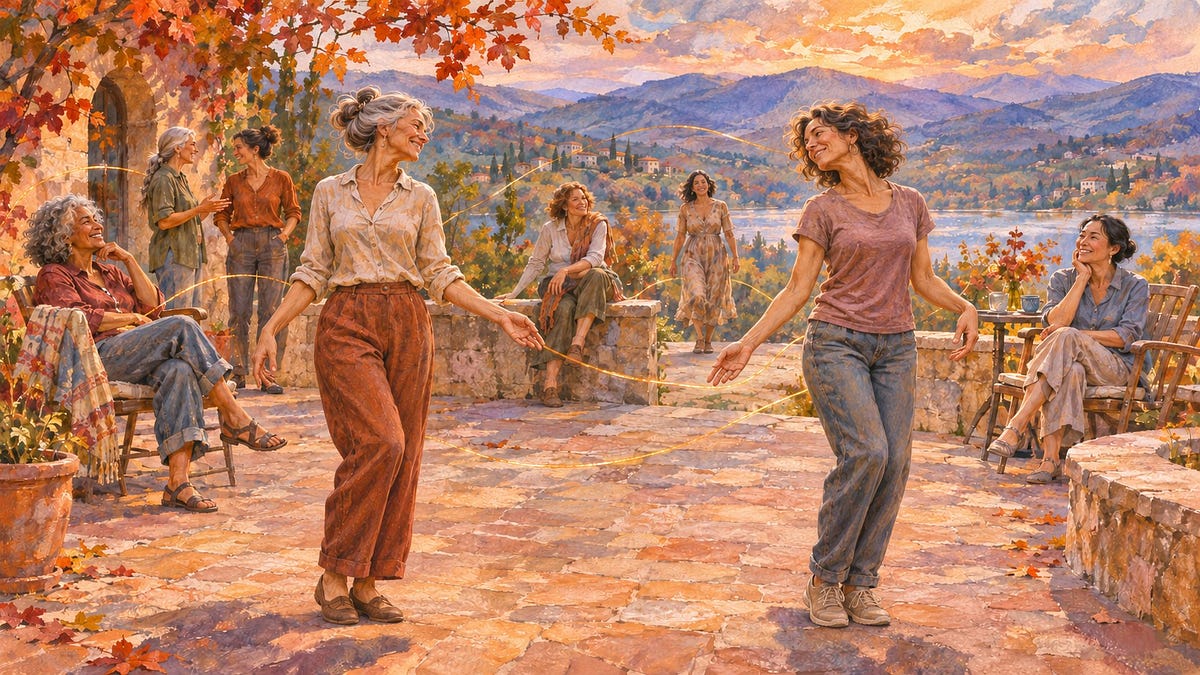
Very often, when I listen or contemplate something, a visual representation emerges within me. I have learned how much an image can carry when I offer it back. As I write about structure and emergence now, I see two people dancing the Tango: each alive in their own movement, each listening and responding to the other, their distinctness making the dance possible.
I can feel something of our preparation in that image. We would give the inquiry a shape, return to it together, sense where it needed to change, and find the next movement. There was so much pleasure in this shared creation. We were also still getting to know one another’s ways. Giving shape to something we cared about many times brought new questions we needed to explore together.
Perhaps you know that exciting moment: an expression of your purpose that you have carried meets another person’s enthusiasm. You feel the resonance, and suddenly there is something between you that asks for the care of you both.
From conversation to Gathering Arc
Each collaboration unfolded through many conversations.
We spoke about what had drawn us to the Matriarch inquiry, the women who might come, and the questions already alive where each Gathering would take place. My collaboration partners brought worlds of experience into these exchanges: relationship with land and soil, living systems, education, health and circadian rhythm, homestead life, cultural context, and the meeting of generations. I brought the Matriarch inquiry, Conscious Collaboration, and my own continuing exploration of the unification of Love and Power.
As I listened, I began to sense where these contributions could meet. What was the guiding question that belonged to this Gathering? How might women arrive, begin to trust the circle, and enter the inquiry? What might they experience together and carry into their lives afterward?
Gradually, I could begin to write down a movement that held what I was hearing. We came to call it a Gathering Arc.
This Arc described the underlying movement of the inquiry: its central question, its different phases, and the purpose of each phase. Seeing these come together across the pages began to reveal the bigger picture of what we were co-creating. It gave us something we could return to together. We could begin to sense the whole Gathering, follow its movement, and notice where our understanding still needed to deepen.
Once I had captured the Arc in a shared document, we reviewed it, questioned it, added to it, and simplified it. My partners enriched it with their sense of what needed further tending. The conversations continued through and around the document.
Sometimes a question was carrying too much. Sometimes the frame had become too narrow. Sometimes we had brought so many rich possibilities that the question of what belonged together needed another round of listening.
I was discovering how much the Arc could change through this exchange. Something I had understood in one way became clearer through my collaboration partner’s response. A question could become simpler. A possibility could open that I would have been unable to see from my own perspective. The inquiry I had brought was becoming a shared form, and I was learning through the shaping of it.
I began to realize that, through the very process of preparing together, we were already living the inquiry into the Matriarch archetype.
Four places, four expressions
At Heartwood Farm, our first frame leaned toward a Gathering for Regenerative Farmers. We had gathered so many possible questions around it that the centre was becoming difficult to feel.
Through conversation with Michelle and Val, the invitation widened beyond women engaged in Regenerative Farming. We were inviting women drawn into deeper relationship with land, soil, food, ecology, and the communities in which they live—to feel and consciously inhabit our belonging to the Sacred Web of Life through these relationships.
Near Montreal, Michelle and I were imagining a small circle at her home by a lake, with two evenings and the day between them. Having that much time together opened particular possibilities. We could prepare our meals together, and sleep, wake, and return to the circle with something that had continued to settle within and between us.
I was drawn to the spaciousness of that rhythm. A question could accompany us beyond a session. Something heard in the circle might find its next expression while we prepared a meal or went for a hike. As we shaped the Arc, we could imagine the inquiry moving through these different kinds of time. Gathering in a circle would flow into the intimacy of sharing time and place over more than a day.
Puyallup invited a different kind of attentiveness. What Chrystal and I had first imagined across two days became one day, with three participating women and the two of us co-hosting. That small constellation gave us a very particular circle to prepare for. We let its intimacy refine the Arc, listening for how each woman could have room to be seen and heard. The recognition of women’s gifts became central, along with the question of how we might strengthen one another in trusting what we were ready to bring into form.
In El Salvador, Lisa and I were preparing for a larger circle spanning generations. Our conversations brought me into closer relationship with the context in which we would gather. Lisa spoke about the legacy of violent conflict, trauma carried across generations, and the different cultural and spiritual lineages present around her. We explored what it might mean for women of different ages to meet in that complexity, to listen across their experiences, and to nourish the passage of wisdom between generations.
These conversations touched me deeply. I was coming toward a place whose history and present I had much to learn about. Preparing the Gathering with Lisa meant beginning that learning, listening to what she knew of the women and the place, and sensing how our inquiry could meet what was already alive there.
Another experience profoundly influenced how I could relate to the land, people, culture, and history of El Salvador. Lisa was invited to the 18 Círculo de abuelas y abuelos sabios del planeta tierra, an international gathering of Indigenous elders, and through her presence there, I too received an invitation to participate. The gift of that invitation and the life-changing experience of being there deserve their own space in this story. Here, I want to acknowledge how deeply the encounter informed the listening I brought to our Gathering.
Across these four preparations, the Arc kept bringing us back to the people and place before us. Each time we returned to the question of how to give the inquiry form, there was something particular to attend to. I felt the generosity of that:
Each collaboration was teaching me something about the inquiry I had set out to offer.
Finding a flow we could hold together
Once an Arc felt true enough, we began to imagine its practical expression in a Gathering Flow Structure.
Now we could move through each Gathering together in our imagination. Women would arrive. We would welcome them. At some point, we would invite them to begin speaking into the circle. There would be silence, movement, food, and time with the place. We needed to discover a rhythm for these movements and understand how we would hold them together.
Who would offer an invitation? Who would attend to what followed? How much time might women need to arrive? Where could a pause give an experience time to settle? What would we need to prepare so that nourishment, accessibility, and the practical care of the place were attended to?
These questions brought our care into detail. Sequence, timing, roles, transitions, materials, and agreements began to take their place in the Flow Structure. Each choice returned us to what we hoped the women could experience, and to what we could responsibly offer together.
Perhaps you know the experience of preparing to welcome people into something that deeply matters to you. You think about the invitation, the space, the food, the time. Each choice grows from your connection with the purpose of coming together. What kind of field are you inviting people into? How might these choices make room for the potential and possibilities that can emerge among everyone present?
These questions ran through our preparation. We wanted the intention of each movement to remain alive in how we were present throughout the Gathering. Tending the sequence, the timing, and our respective roles gave us a shared orientation we could return to as we listened. We would enter the questions and the silence with the women, discovering together what emerged. The care we took beforehand became part of our capacity to respond together.
The caring attention we gave to the preparation also nourished our relationships, personally and as co-hosts. It feels worth honoring again how much trust this held:
In each collaboration, we were bringing something into being together, never having co-created with one another before.
We were discovering how we listened, what each of us noticed, and where we needed more clarity from each another. Shaping the Flow Structure, as we had the Gathering Arc, gave those discoveries a practical place. We could return to both as our shared sense of what we were co-creating deepened.
This was the Tango becoming tangible: thoughtful preparation and the willingness to be moved by what we encountered, each giving the other something to respond to.
An invitation before we met
As the Arcs found expression in Gathering Flow Structures, I began to recognize another part of the preparation that was mine to tend.
The women would receive an invitation and practical information. I wanted them to be able to sense more of what they were entering: what I meant by the Matriarch’s Call, how I was holding the inquiry, and what kind of listening we hoped to practice together.
I had been living with these questions for a long time. The women would each come through their own relationship with them. Writing offered a way to meet them before we shared a room, to make my own understanding available so that they could sense the invitation with their own discernment.
This led me to write The Matriarch’s Call: How I Hold Her as a Living Inquiry, a living Handbook that I offered to the participants before the Gatherings.
Writing it asked me to pause within all the preparation and say what mattered most to me.
I wanted to introduce the Matriarch as an archetypal presence of the mature feminine, and to share how I was coming to know Her. The unification of Love and Power was at the centre: tenderness and strength, care and boundary, agency and responsibility, moving together in service to life. My own listening was one encounter with a presence we would approach through many lives and perspectives.
I also wanted to make room for the woman who might read these pages and wonder how she would belong in the circle. She would bring her body, her history, her culture, her gifts, her wounds, and her ways of making meaning. The inquiry would deepen through the meeting of these experiences. Would she feel called to enter with her own questions?
The Handbook continues to offer a ground for future collaborations and Gatherings. It invites presence, deep listening, embodiment, and openness to the unknown. It speaks of listening from an inner place where attention to another woman becomes a deep practice of witnessing. Of speaking from our own experience. Of staying with a question and discovering what silence, an image, a bodily response, or another woman’s words might reveal.
Consent, choice, pacing, and boundaries belong throughout. A woman can speak, remain silent, move, be still, or step back. Difference can nourish the intelligence of the circle. Trust can ask for our continuing care, clarity, and responsiveness.
And the inquiry belongs within the Sacred Web of Life. The land beneath us, the water, weather, food, and more-than-human presences are part of the relationships through which we listen. Story, movement, and ritual-sensitive space offers ways to encounter what might still be finding words.
As I wrote, the relationship between the Handbook and the Arcs and Flow Structures became clearer to me. I was making visible the understanding that had been informing our choices all along. The Handbook gave the women an orientation; writing it deepened my own. It became another way of preparing to welcome them.
You can read and download The Matriarch’s Call Handbook here.
At the threshold of the circle
Looking back, I feel how much of our care had already entered these Gatherings before the women arrived.
It lived in the conversations we returned to, the questions we explored—sometimes repeatedly— the room we made for each other’s contributions, and the practical decisions through which we prepared to share responsibility. It lived in the openness to keep listening as a form became clearer.
The Arc gave us a sense of the inquiry’s deeper movement. The Flow Structure gave that movement a rhythm we could hold together. The Handbook reached toward the women who would join us. Through all three, we were giving expression to the unification of Love and Power: tending form with great care, making choices, honoring boundaries, and acting in service to life.
I return to the image of the Tango. Its beauty lives in the continuing responsiveness of the two dancers, in the attention through which each movement becomes an invitation to the next. Structure and emergence were asking that kind of presence of us. We had been practicing it together through the preparation.
Then came the moment we had been imagining: women arriving, bringing themselves into the space we had prepared.
I had spent months asking what might become possible when we gathered around the Matriarch’s Call.
Now I would sit among these wonderful women who had said yes to our collective inquiry. We would discover it together. What would happen as we began to listen? What would these particular women make visible to one another? And how would I be changed by entering the circle myself?
That is where I would like to take you next: into the Gatherings, where our carefully tended intentions met the women who would give them life.
With love,
Christiane